
Cosco containerships abandon attempt to exit Middle East Gulf
Despite dialogue between Beijing and Tehran only this week, two Chinese-owned containerships have been turned away from the approved route through the Strait of Hormuz
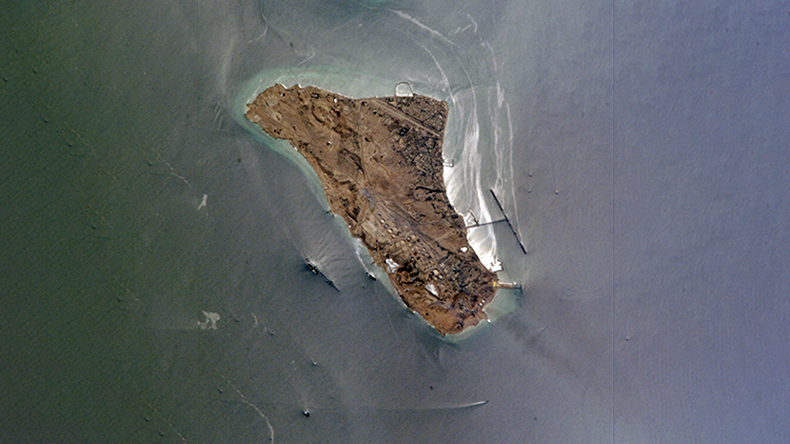
TWO Cosco Shipping-operated boxships have diverted last minute while attempting to leave the Middle East Gulf, according to Lloyd’s List Intelligence data.
The 19,100 teu CSCL Indian Ocean (IMO: 9695157) and 19,000 teu CSCL Arctic Ocean (IMO: 9695169) started sailing towards the Strait of Hormuz on Thursday evening.
The two ultra-large containerships undertook U-turns shortly after reaching the Tehran-approved Larak Island corridor at around 03:20 UTC. Both operate on Cosco’s MEX service, which links Chinese ports with Middle East hubs such as Dammam and Jebel Ali.
These are the third and fourth vessels to have been tracked abruptly changing course while trying to sail out of the Gulf.
A 75,120 dwt bulk carrier, Lotus Rising (IMO: 9217656), also failed to complete a transit through the Strait of Hormuz on March 26.
Lotus Rising was using its Automatic Identification System data to indicate it had come from the Iranian port of Bandar Khomeini and is owned by a Chinese company.
It is unclear why the vessel was unable to pass. Iran has been shepherding through “friendly” bulkers in recent days, including non-Iranian owned vessels that have previously called at its domestic ports.
The two Cosco vessels are not the first containerships to turn around while attempting to transit the strait.
St Kitts and Nevis-flagged, 658-teu Selen (IMO: 9208459) attempted to transit the strait on March 24 before it then changed course off Qeshm Island at around 0830 hrs.
Iranian Revolutionary Guard Corps Navy commander Alireza Tangsiri said the containership did not have permission to transit the strait.
Any vessel passing through the chokepoint must do so with the full coordination of Iran’s maritime authority, he said in a statement earlier this week. Israel has since claimed it has killed Tangsiri in a strike.
The IRGC has reiterated its control over the Strait of Hormuz in a statement published by affiliated media outlet Fars.
It said it prohibits shipping “to and from ports of allies and supports of the Israeli-American enemies” through any corridor.
It’s not immediately clear why the two Cosco containerships also turned around, but according to their schedule they have both called at Jebel Ali, Dammam and Khalifa Port since mid-February.
Cosco Shipping has been approached for comment.
Control Risks associate analyst Arran Kennedy said the U-turns could be down to an over-zealous official at the “toll booth” who wasn’t satisfied with the paperwork, or a bump in the road in Tehran-Beijing relations.
US weighs risky military options as Iran asserts authority
The U-turns come just days after a call between Chinese Foreign Minister Wang Yi and Iranian Foreign Minister Abbas Araghchi, during which the latter said that the Strait of Hormuz remains open to all and that vessels can pass safely, although countries engaged in the conflict were not under consideration.
In each of the four instances tracked by Lloyd’s List, the vessels appeared to be sailing through the IRGC-controlled corridor, which requires specific clearance codes and an Iranian escort service.
The “toll booth” scheme has effectively enabled Iran to control traffic through the Strait of Hormuz, enabling it to allow some vessels through while keeping the strait closed to what it perceives as its enemies.
The strait, and particularly the normal route that does not require vessels to detour around Larak and coordinate with the IRGC, is technically open.
However, no vessels have been tracked with AIS taking the normal route since March 15.
“The line I’ve always had is that Iran only does this when the regime is existentially threatened, and that’s what the US has done. So Iran pulled the ‘strait card’,” said Control Risks director Cormac McGarry.
He warned that those vessels that choose to make use of Iran’s scheme could find themselves at the pointy end of US sanctions in the future.
McGarry also doubted Iran’s ability to control the strait for any significant period of time. Tehran has demanded sovereignty over the chokepoint as part of its demands for an end to the conflict, perhaps with a view to charge what McGarry called a “canal fee” for each transit.
But Gulf neighbours are unlikely to tolerate such an arrangement for long, he said.
More plausible is that Iran could effectively control the strait for four to six weeks, “and we’re now in that period”.
Despite Iran appearing to hold the initiative, McGarry noted that the US military still has options available.
News that the US is readying ground troops has been met with suggestions that it will attempt to take Kharg Island, where much of Iran’s oil is loaded, or coastal areas surrounding the Strait of Hormuz.
McGarry said those options were “terrible” and would likely come with high casualties.
A US‑led protection scheme using destroyers in the strait could push 10 or so vessels through the chokepoint at a time, he said, but it would place valuable assets and personnel directly in harm’s way, which would be a very different proposition from operations in the Red Sea.
“You’re dealing with different weaponry at a much shorter range,” he warned.
“Imagine the American public seeing the US flag on one of their $2bn destroyers sinking into the Strait of Hormuz.”
All Strait of Hormuz transits are verified by Lloyd's List Intelligence expert analysts using our AIS vessel tracking data, advanced analytics, and on-the-ground human intelligence to ensure even dark or GNSS-disrupted movements are captured. Lloyd’s List Intelligence subscribers can activate the Strait of Hormuz transit watchlist here